| Garment Type |
Golf top or performance shirt with sleeves and a close but non-restrictive fit |
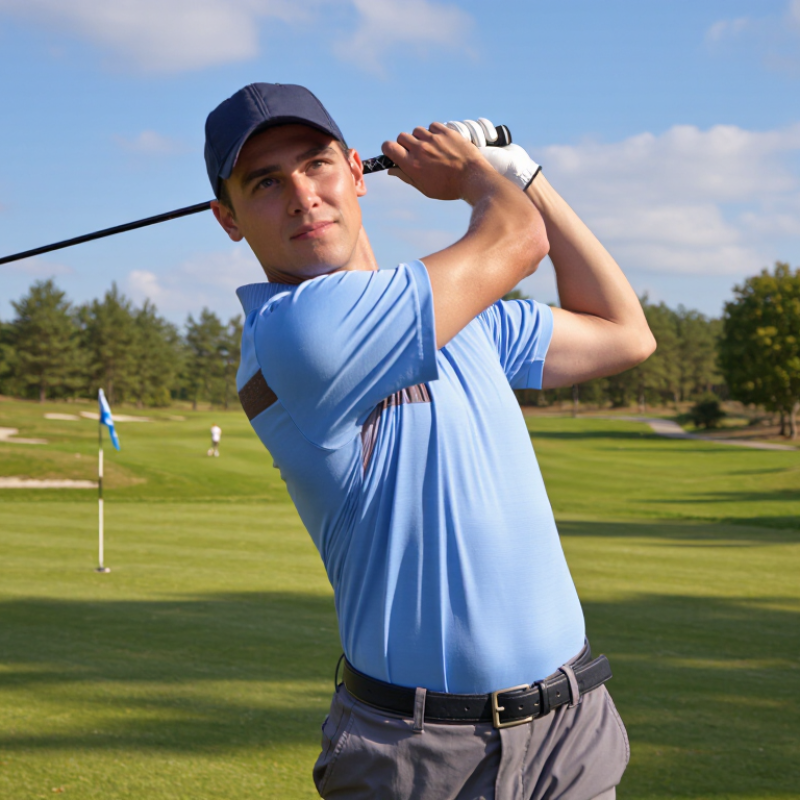
A golf top is designed for repeated shoulder, arm, and torso movement while providing coverage during outdoor play. |
Supports a full swing without excessive fabric movement and helps cover commonly exposed areas such as the shoulders, upper back, and arms. |
Raise both arms, rotate the shoulders, and perform a golf-swing motion before purchasing. |
| Ultraviolet Protection |
UPF 30–49 for strong everyday protection; UPF 50+ for the highest listed protection level |
UPF 30 allows approximately 3.33% of erythemally weighted UV radiation to pass through. UPF 49 allows about 2.04%. UPF 50 allows about 2%, while UPF 50+ is rated at 50 or higher. |
Golf rounds often involve several hours of continuous outdoor exposure, so higher UPF can reduce UV transmission through the fabric. |
Look for a UPF value supported by a recognized test report rather than relying only on fabric color or thickness. |
| Test Method |
AATCC TM183 testing for ultraviolet transmission and UPF calculation |
AATCC TM183 evaluates the amount of UV radiation transmitted through a textile and uses the results to calculate ultraviolet protection factor. |
Testing provides a more objective basis for comparing garments than visual appearance alone. |
Check whether the documentation identifies AATCC TM183, the tested fabric or garment, conditioning details, and the reported UPF result. |
| Coverage |
Short sleeves for hot conditions; long sleeves or a higher neckline for greater coverage |
UPF applies to the tested covered material. Exposed skin is not protected by the garment. |
Neck, shoulders, upper arms, and forearms can receive substantial sun exposure during a round. |
Assess sleeve length, neckline height, hem coverage, and whether the shirt stays in place during movement. |
| Fabric Opacity |
Opaque, tightly constructed fabric with minimal visible light transmission |
Fabric construction, weight, stretch, color, moisture, and wear can influence UV transmission. A visual check cannot replace UPF testing. |
Thin or highly stretched areas may provide less coverage than the fabric appears to provide when relaxed. |
Inspect the fabric in bright light and choose the tested size and construction that best match the intended use. |
| Fit and Stretch |
Comfortable athletic fit with controlled stretch and no excessive pulling across the shoulders |
Stretching can reduce fabric thickness and alter the coverage of the textile in use. |
A well-balanced fit preserves freedom of movement while helping the garment maintain coverage during the swing. |
Check shoulder seams, chest comfort, sleeve mobility, and whether the fabric becomes visibly strained when reaching forward. |
| Moisture Management |
Moisture-wicking construction that dries efficiently without feeling clammy |
Wicking moves liquid moisture away from the skin; drying speed depends on fiber type, fabric structure, humidity, airflow, and garment thickness. |
Helps improve comfort during walking, repeated swings, and warm-weather play. |
Review the care label and fabric specifications, then consider how the garment feels during light activity. |
| Breathability |
Air-permeable fabric or ventilation panels placed where heat builds up |
Breathability is affected by fabric structure, air permeability, garment fit, and vent placement. |
Improves heat comfort without requiring a very loose fit that could interfere with the swing. |
Look for mesh or engineered ventilation zones at the back, underarms, or side panels, while confirming that the tested protective areas remain covered. |
| Sun Protection Strategy |
Combine the golf top with a broad-brimmed hat, sunglasses, sunscreen, and shade when available |
UPF measures protection provided by the covered textile only; it does not protect uncovered skin, eyes, or the face. |
A layered approach reduces reliance on one garment and covers areas that a golf top cannot cover. |
Use broad-spectrum sunscreen on exposed skin and reapply according to the product directions, especially after sweating. |
| Care and Durability |
Follow the garment care label and avoid practices that damage fabric structure |
Repeated wear, abrasion, stretching, harsh chemicals, and incorrect laundering may affect fit, appearance, or protective performance. |
Maintains comfort and helps preserve the garment’s intended construction over time. |
Inspect for thinning, permanent stretching, loose seams, or damaged ventilation panels and replace the garment if coverage is compromised. |
| Best Choice by Playing Condition |
UPF 50+ long-sleeve top for prolonged, high-exposure play; UPF 30–49 for substantial but lower-rated protection |
UPF 50+ permits no more than approximately 2% of erythemally weighted UV radiation through the tested fabric, while UPF 30–49 permits approximately 3.33% to 2.04%. |
Higher-rated coverage is especially useful for long rounds, high-UV conditions, exposed courses, and people seeking to minimize UV transmission through clothing. |
Prioritize the highest verified UPF rating that still provides suitable mobility, breathability, and comfort. |









 Newsletter