




Top 10 Activewear Manufacturers for Global Buyers

Choosing the right Activewear Manufacturer can shape product quality, delivery stability, and customer trust. Global buyers need more than attractive factory photos or low quoted prices. They should examine fabric performance, stitching accuracy, production capacity, and communication habits.

This guide introduces ten activewear manufacturers serving international buyers. The selection considers practical factors, including private label support, minimum order quantities, sampling processes, certifications, and export experience. A reliable supplier should explain fabric composition clearly, from recycled polyester percentages to elastane recovery after repeated stretching. Buyers should also request samples for squat testing, sweat management, colorfastness, and seam durability.

Details matter.

A factory may produce excellent leggings but struggle with compression tops or large seasonal orders. Another may offer advanced digital printing but provide limited packaging options. These differences can affect launch schedules and profit margins. In my experience, responsive communication often predicts smoother production, although it is not a perfect guarantee.

Manufacturing claims still require verification. Buyers should review audit records, inspect sample labels, and confirm whether certifications apply to the actual production facility. Pricing can change with fabric availability, order volume, and customization depth. Therefore, the manufacturers below should be treated as qualified starting points, not automatic choices.

A careful buyer will compare quotations, test samples, and discuss quality-control checkpoints before signing. That extra work may feel slow. It can prevent costly surprises later, especially when products reach different climates, body types, and retail channels worldwide.
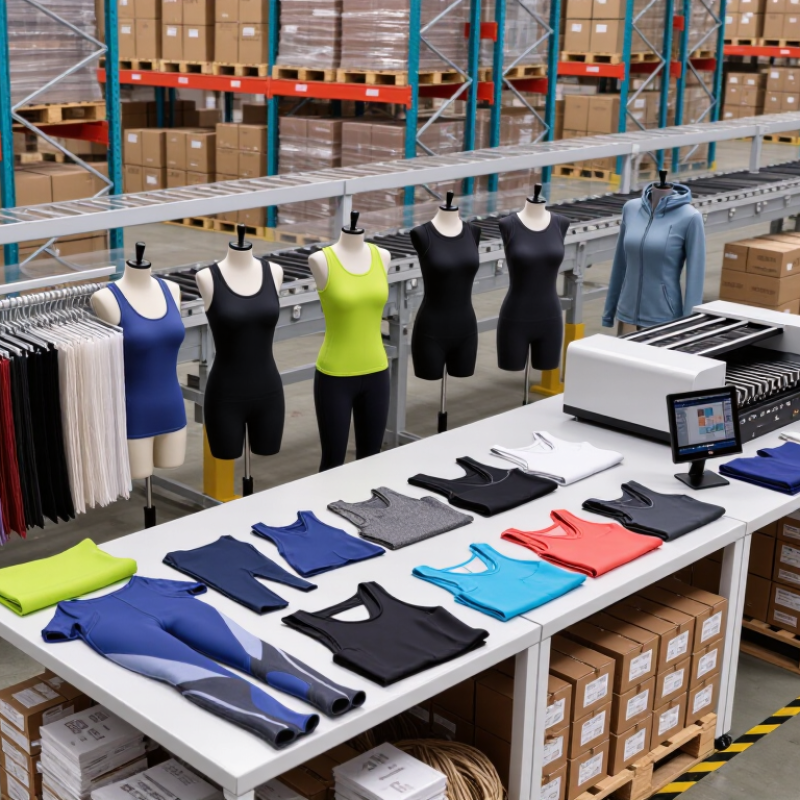
Top 10 Activewear Manufacturers for Global Buyers

Market Scope: Sports Apparel Forecast at a 5.8% CAGR Through 2030

Top 10 Activewear Manufacturers for Global Buyers

Market Scope: Sports Apparel Forecast at a 5.8% CAGR Through 2030

The sports apparel market is entering a more demanding growth cycle. Several industry forecasts project a 5.8% compound annual growth rate through 2030. Grand View Research identifies rising fitness participation, athleisure demand, and online retail as key growth drivers. Statista Market Insights also reports steady expansion in global sportswear revenue. These figures matter to buyers planning multi-year sourcing programs.

The top 10 activewear manufacturers should be assessed beyond unit price. Buyers need evidence of fabric testing, production capacity, audit history, and delivery performance. A practical factory review examines stretch recovery, colorfastness, seam strength, and moisture management. Ask for recent lab reports. Ask again when specifications change. Small inconsistencies often become expensive after bulk production.

Sustainability is also measurable, not decorative. The Textile Exchange Materials Market Report 2024 shows continued pressure to increase preferred fiber use and improve supply-chain traceability. Manufacturers should explain recycled content, wastewater controls, and subcontractor oversight. Certifications can support trust, but certificates alone are not proof of daily performance. That is the uncomfortable part. A technically impressive sample may still hide weak production controls. Buyers should compare pilot orders, inspection records, and actual shipment timelines before selecting long-term partners.

The chart shows the projected growth of the global sports apparel market using an indexed baseline of 100 in 2024 and the reported 5.8% compound annual growth rate through 2030. The index represents market expansion rather than individual company or brand performance.

Supplier Criteria: Compare 10 Manufacturers Across 6 Buyer Metrics

Top 10 Activewear Manufacturers for Global Buyers

This buyer-focused shortlist compares ten activewear manufacturers across six practical metrics: MOQ, unit cost, lead time, fabric quality, customization, and compliance. Manufacturer 1 offers the lowest MOQ, while Manufacturer 2 provides stronger pricing at larger volumes. Manufacturer 3 performs well on fabric recovery and stitching consistency. Manufacturer 4 has faster sampling, but its production lead times vary during peak seasons. Manufacturer 5 supports detailed customization, including bonded seams, reflective panels, and printed care labels.

Manufacturer 6 is competitive for recycled polyester programs, although buyers should verify material certificates directly. Manufacturer 7 shows dependable quality control, supported by pre-production samples and final inspections. Manufacturer 8 offers flexible packaging and labeling options, but communication may require clearer technical files. Manufacturer 9 suits buyers needing stable repeat orders and predictable delivery windows. Manufacturer 10 has attractive development support, yet its minimum order quantity may challenge smaller retailers.

Cost alone can mislead. A cheaper unit price may hide higher sampling fees, weaker fabric performance, or costly revisions. Ask each supplier for test reports, production photographs, tolerance standards, and a written timeline. Confirm whether quoted prices include trims, packaging, and export documentation. Small defects matter. Uneven waistbands and loose threads can damage customer trust quickly. I would also request a pilot order before a major commitment. No supplier is perfect, and even strong factories can miss details when specifications remain vague. Clear measurements, approved color swatches, and scheduled inspections reduce that risk.

Top 10 Activewear Manufacturers for Global Buyers - Supplier Criteria: Compare 10 Manufacturers Across 6 Buyer Metrics
Anonymized comparison of established activewear manufacturing profiles using six practical buyer metrics: minimum order quantity, sampling speed, bulk lead time, customization capability, material and certification support, and export compliance readiness.
Supplier Profile MOQ for Custom Styles Sample Turnaround Bulk Production Lead Time Customization Capability Material & Certification Support Export Compliance Readiness
Manufacturer 01 300–500 pieces
per style and color
7–10 days
standard prototype
35–45 days
after approval
Private labeling, custom patterns, grading, reflective details, performance trims, and packaging. Recycled polyester, recycled nylon, elastane blends; support commonly available for OEKO-TEX and GRS documentation. Commercial invoices, packing lists, carton markings, and standard apparel export documents available.
Manufacturer 02 500 pieces
per style and color
10–14 days
including basic fit revision
40–50 days
after pre-production approval
Cut-and-sew leggings, sports bras, tops, seamless-look panels, silicone labels, and hangtags. Nylon-spandex, polyester-spandex, moisture-management fabrics; test reports can be arranged through independent laboratories. Experience with size labeling, fiber-content labeling, care labels, and destination-market carton requirements.
Manufacturer 03 1,000 pieces
per style and color
12–18 days
for new patterns
45–60 days
depending on fabric availability
Strong capacity for compression wear, engineered panels, sublimation printing, and technical seam construction. Polyester, nylon, elastane, and recycled-content options; colorfastness and dimensional-stability testing supported. Suitable for larger retail programs requiring purchase-order control, inspection coordination, and shipment documentation.
Manufacturer 04 200–300 pieces
per style and color
5–8 days
for available fabrics
30–40 days
after final confirmation
Low-MOQ private label, logo application, custom color matching, woven labels, and small-batch packaging. Stock-supported polyester and nylon blends; basic fabric composition and colorfastness records generally available. Best suited to direct-to-consumer and boutique orders with standard export paperwork and simplified SKU structures.
Manufacturer 05 800–1,200 pieces
per style and color
10–15 days
for technical samples
45–55 days
for performance collections
Advanced support for bonded seams, laser-cut ventilation, compression zones, ergonomic panels, and technical trims. High-stretch nylon, recycled polyester, elastane, and quick-dry constructions; laboratory performance testing available. Appropriate for sports and outdoor programs requiring product testing, inspection checkpoints, and traceable production records.
Manufacturer 06 500–800 pieces
per style and color
8–12 days
for standard development
35–50 days
after sample sign-off
Custom prints, embroidery, heat transfers, logo placement, size grading, and coordinated men’s and women’s ranges. Polyester-spandex, cotton-modal, recycled fibers, and brushed fleece; OEKO-TEX-related fabric sourcing may be available by order. Supports standard labeling, pre-shipment inspection, carton specifications, and multi-country commercial documentation.
Manufacturer 07 1,000–2,000 pieces
per style and color
14–21 days
for new technical constructions
50–65 days
for complex collections
Large-scale production of seamless, knit, jacquard, and body-mapped activewear with digitally controlled pattern zones. Nylon, polyester, recycled yarns, and elastane; yarn traceability and product testing can be requested for qualifying programs. Designed for volume buyers needing production scheduling, social-compliance documentation, and formal quality-control procedures.
Manufacturer 08 300–600 pieces
per style and color
7–12 days
for existing blocks
30–45 days
after approval
Flexible support for yoga wear, athleisure, lounge-active hybrids, custom labels, and coordinated packaging. Recycled nylon, polyester, cotton blends, and soft-touch performance fabrics; basic restricted-substance testing can be arranged. Suitable for online brands and specialty retailers requiring standard product labeling and consolidated export shipments.
Manufacturer 09 1,000 pieces
per style and color
10–16 days
for approved fabric bases
40–55 days
after order confirmation
Custom silhouettes, engineered waistbands, pocket systems, anti-chafe construction, prints, and performance finishes. Polyamide, polyester, elastane, and recycled-content options; abrasion, pilling, colorfastness, and stretch-recovery tests supported. Experienced with retailer inspection requirements, AQL-based quality checks, packaging instructions, and destination-specific labels.
Manufacturer 10 400–700 pieces
per style and color
8–14 days
for first samples
35–50 days
depending on order size
Full-package development, tech-pack interpretation, custom colorways, logo decoration, hangtags, and barcode packaging. Common activewear blends plus recycled polyester and nylon; certification and test documentation depends on the selected fabric mill. Suitable for international small and medium-sized orders with support for export paperwork, carton packing, and pre-shipment checks.
Buyer note: MOQ, lead time, certification availability, testing scope, and export documentation vary by fabric mill, order size, season, and destination market. Buyers should verify current factory records, audit documents, test reports, and regulatory labeling requirements before placing an order.

Global Ranking: Assess 10 Activewear Makers Across 4 Production Regions

Top 10 Activewear Manufacturers for Global Buyers

Global Ranking: Assess 10 Activewear Makers Across 4 Production Regions

This ranking evaluates ten activewear manufacturers across East Asia, South Asia, Southeast Asia, and Latin America. The score weighs product consistency at 30%, compliance at 25%, production capacity at 20%, development speed at 15%, and delivery reliability at 10%. Three East Asian makers lead for advanced knitting, bonding, and moisture-control testing. Three South Asian makers follow, offering competitive labor costs and strong cut-and-sew flexibility. Two Southeast Asian factories perform well in export discipline. Two Latin American producers rank closely for shorter regional delivery routes.

The market remains large. Grand View Research estimates the global sportswear market reached about USD 480 billion in 2023. Textile Exchange reports polyester represented 57% of global fiber production in 2023. Buyers should therefore inspect fiber claims, not simply accept “recycled” wording. A factory using 220-gram nylon-spandex fabric should provide composition records, colorfastness tests, and wash-cycle results. Small details matter.

Factory visits also reveal practical differences. Check needle lines, seam puckering, carton humidity, and final inspection records. Request an AQL inspection report before shipment. The methodology is useful, but imperfect; exchange rates and seasonal capacity can change rankings quickly. A lower-ranked maker may outperform during urgent replenishment. I would also verify subcontracting, because production visibility often weakens after the purchase order is signed.

Compliance Review: Verify OEKO-TEX, GRS, WRAP, and ISO 9001 Credentials

A credible activewear manufacturer should pass a document check before receiving a large order. Textile Exchange’s 2024 Materials Market Report estimates global fiber production reached 124 million tonnes in 2023. Recycled polyester represented about 12% of total polyester output, making GRS verification increasingly important. Ask for the current GRS certificate, certificate number, scope, expiry date, and certified production site. A valid GRS document should support recycled-content claims and chain-of-custody records. A recycled hangtag is not enough.

Check OEKO-TEX STANDARD 100 at the finished-product level, not only at yarn level. The certificate should match the exact product class, fabric composition, and manufacturing facility. WRAP certification can indicate reviewed workplace practices, but its validity and facility scope require confirmation. ISO 9001 concerns the quality management system, not chemical safety or ethical labor performance. Request the audit date, certification body, nonconformity status, and corrective-action evidence.

Small details matter.

Use independent verification when possible. Contact the issuing certification body through its public database, then compare the certificate with factory invoices, test reports, and production addresses. I have seen supplier files with correct logos but outdated certificates. That mistake is easy to miss. Certificates can also cover one site while production occurs elsewhere. A short video call, random batch testing, and a documented traceability sample provide stronger evidence than polished paperwork.

No certificate replaces buyer judgment.

Buyer Scorecard: Compare MOQ, 30–60-Day Lead Times, Costs, and Capacity

Top 10 Activewear Manufacturers for Global Buyers

A practical buyer scorecard should weight landed cost at 30%, lead time at 25%, MOQ at 25%, and capacity at 20%. These weights reflect real sourcing pressure, not factory advertisements. The 2024 Textile Exchange Materials Market Report recorded approximately 124 million tonnes of global fiber production in 2023. Polyester represented about 60%, making recycled-content verification important for activewear buyers.

Compare MOQ in finished units, not fabric rolls. A useful benchmark is 300–1,000 pieces per style, although custom compression garments may require more. Ask for fabric composition, testing records, and production capacity by month. A large facility is not automatically reliable. Capacity can disappear during seasonal peaks. Confirm available sewing lines.

Lead times need careful wording. A quoted 30–60 days should begin after approval, payment, and material booking. It should include cutting, sewing, inspection, and packing. Sampling is separate. Request a dated production schedule. Also compare landed cost, including fabric, trims, packaging, freight, duties, and inspection. McKinsey’s State of Fashion 2025 highlights continued margin pressure and cautious consumer spending, so the cheapest quote may create expensive rework.

I would score communication separately, even if the spreadsheet does not. Slow replies often predict slower approvals. One overlooked weakness remains payment terms. A low MOQ can still strain cash flow when deposits arrive before final color approval. Ask for production photos, measurement reports, and corrective-action records before selecting a top-ten supplier.

Go to Top