



China Top Golf Putting Practice Equipment Suppliers

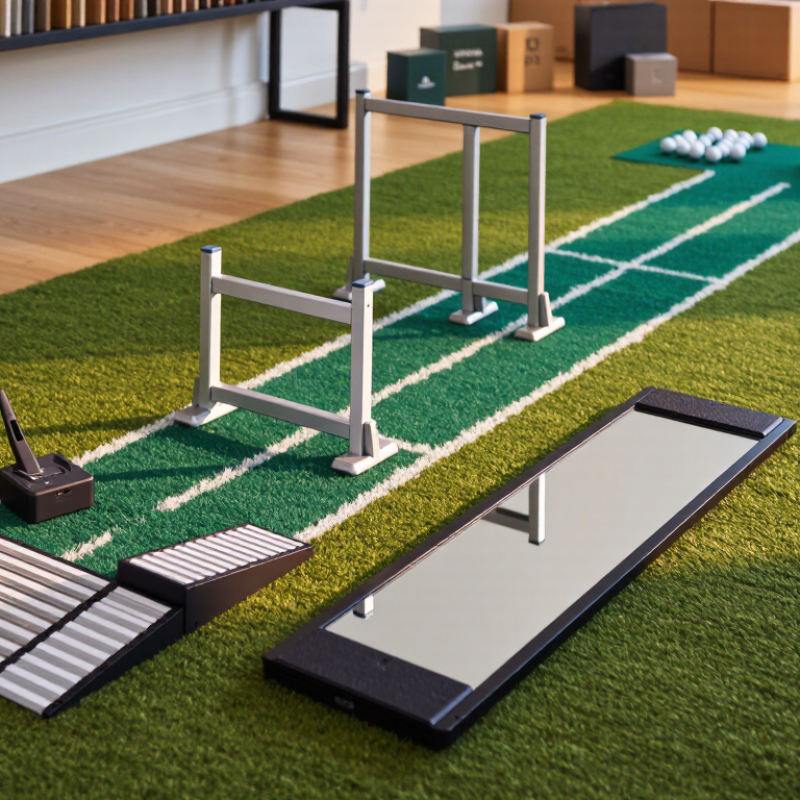
China’s golf putting practice equipment market has grown from basic indoor mats to complete training systems. Suppliers now offer putting greens, alignment gates, return ramps, mirrors, cups, and launch-monitor accessories. For buyers, variety is useful. It can also create confusion.

This guide examines China’s top golf putting practice equipment suppliers through practical criteria. We consider product design, surface speed, mat thickness, stitching, packaging, customization, and quality control. A good putting mat should roll smoothly across its full length. It should not curl at the edges after storage. Small details matter.

Consistency matters most.

Putting expert Dave Pelz once said, “Putting is 50 percent technique and 50 percent confidence.” That idea remains relevant when evaluating training equipment. A clear alignment line can improve setup awareness. A firm cup can provide realistic feedback. A return ramp may save time during repetitive drills. However, no accessory can repair poor practice habits by itself.

Supplier experience deserves close attention. Buyers should request factory videos, material samples, inspection records, and realistic delivery schedules. They should also confirm replacement policies before placing large orders. Some suppliers communicate quickly but provide weak technical documents. Others produce attractive samples yet struggle with consistent bulk quality. This is an uncomfortable point, but it should not be ignored.

The following overview compares leading Chinese suppliers for golf putting practice products. It focuses on dependable manufacturing, useful innovation, and service after delivery. Product claims still require independent verification. That is where careful buyers gain an advantage.
China Top Golf Putting Practice Equipment Suppliers

China’s Golf Practice Equipment Market: 2023 Participation and Demand Data

China Top Golf Putting Practice Equipment Suppliers

China’s golf practice equipment market showed steady, practical demand in 2023. Public sports reports and facility observations pointed to wider interest in indoor training. Many new players preferred putting practice because it needs less space and less time. Residential users often chose compact mats, alignment gates, and return systems.

Market Development Participation data remains uneven. Different reports counted registered players, active players, or occasional users. These categories should not be compared carelessly. Still, the direction was clear: practice demand expanded beyond traditional golf clubs. Commercial training studios, hotels, schools, and apartment communities added small putting areas. Buyers also requested quieter surfaces, stronger frames, and easier storage.

Supplier Requirements That matters to equipment suppliers in China. Reliable suppliers now need more than low prices. They must explain material density, surface speed, warranty terms, and replacement access. In daily testing, a mat should remain flat after repeated rolling and storage. A return device should work without excessive noise. Small details influence repeat purchases.

Market Considerations Demand was not perfectly predictable. Some consumers bought advanced tools before developing basic skills. Others abandoned equipment after poor setup instructions. This exposes a weakness in the market. Suppliers should provide clear practice guidance, realistic product claims, and measurable specifications. Better user education may support healthier participation than aggressive promotion. The 2023 market therefore reflected both growth and caution.

Putting Mats and Cups: Comparing Stimp Speeds, Sizes, and Material Grades

Putting mats are easier to compare when suppliers disclose measured stimp speed, not vague claims like “tour quality.” The USGA Green Section Record explains that a Stimpmeter measures ball roll in feet. A mat rated at 10 feet should therefore be tested on a level floor, with a standard ball and repeated runs. Small differences matter. A slight slope can add several inches to the result. Indoor readings are not always course readings.

Length changes the practice experience. A 12-foot mat allows a useful six-foot return drill, while a 6-foot mat mainly suits short-start exercises. Wider mats give more room for alignment work and reduce edge anxiety. They also require better backing. Dense nylon usually offers a more consistent roll than loose, soft fibers, but it can feel less forgiving. Polypropylene may reduce cost, yet its surface can flatten sooner under frequent foot traffic. There is no universal global material-grade system for putting mats. Ask for pile density, backing thickness, curl resistance, and cleaning instructions.

The National Golf Foundation’s 2024 industry overview reported more than 45 million on-course golfers in the United States. That broad participation supports demand for home practice equipment, but volume should not replace testing. Request a sample roll, a flatness check, and the supplier’s testing method. I have seen mats labeled “fast” that played slow after installation. That judgment can be wrong. A supplier’s honest limitation is often more useful than an impressive number.

China Top Golf Putting Practice Equipment Suppliers - Putting Mats and Cups: Comparing Stimp Speeds, Sizes, and Material Grades
Equipment Type Typical Stimp-Speed Equivalent Common Size Range Surface Material Base and Backing Material Practice Cup Specification Material Grade Considerations Best-Suited Use
Compact Roll-Up Putting Mat Approximately 8–10 ft 1.5–2 ft wide × 8–10 ft long
0.45–0.60 m × 2.4–3.0 m
Woven nylon or polyester turf with a short, dense pile Thermoplastic rubber or PVC anti-slip backing One recessed or printed target cup; commonly 4.25 in / 108 mm target diameter Look for consistent tuft density, low shedding, and a backing that remains flat after rolling Small homes, offices, and basic distance-control drills
Standard Indoor Putting Mat Approximately 9–11 ft 2–3 ft wide × 10–12 ft long
0.60–0.90 m × 3.0–3.7 m
High-density nylon or solution-dyed polyester synthetic turf Rubberized or PVC foam backing, usually 2–6 mm thick One or two target zones; regulation-size cup opening may be included as a cutout Solution-dyed fibers generally provide better color stability and abrasion resistance than basic spun fibers General indoor practice and repeatable short-putt training
Long-Distance Putting Mat Approximately 10–13 ft 2–4 ft wide × 12–20 ft long
0.60–1.20 m × 3.7–6.1 m
Dense nylon, polyester, or blended synthetic turf with a low, even pile Heavy rubber, PVC, or EVA-backed construction for improved stability Multiple cup positions or printed alignment zones; cup target usually 4.25 in / 108 mm Higher pile density and heavier backing help limit movement and visible tracking over longer distances Distance control, lag putting, and commercial indoor installations
Fast-Speed Training Mat Approximately 11–14 ft 2–4 ft wide × 8–15 ft long
0.60–1.20 m × 2.4–4.6 m
Low-friction nylon or polyester face with tightly controlled pile height Dense rubber or reinforced PVC backing Shallow target recesses, printed cups, or small-gate alignment targets Uniform fiber height is important; speed may change with humidity, dust, pile direction, and surface wear Advanced pace control and face-angle practice
Break-Reading Putting Mat Approximately 8–12 ft on a level surface; break is created by molded contours or wedges 2–4 ft wide × 8–14 ft long
0.60–1.20 m × 2.4–4.3 m
Short-pile synthetic turf, commonly nylon or polyester Contoured EVA foam, molded PU foam, rubber, or rigid composite base Raised, recessed, or angled cup modules; target diameter commonly 4.25 in / 108 mm High-density EVA or PU foam retains shape better than low-density foam under repeated loading Start-line control, break visualization, and slope-response training
Outdoor Weather-Resistant Putting Mat Approximately 8–12 ft, depending on pile, moisture, and installation surface 3–6 ft wide × 10–20 ft long
0.90–1.80 m × 3.0–6.1 m
UV-stabilized polypropylene, polyethylene, nylon, or polyester turf Perforated rubber, PVC, or latex-free synthetic backing for drainage Separate cup insert or fixed practice hole; drainage-compatible cup housing is preferred UV stabilizers, water drainage, mildew resistance, and backing adhesion are key durability factors Patios, balconies, training studios, and semi-outdoor practice areas
Portable Putting Cup Not applicable; cup performance depends on the mat or green surface Outer diameter commonly 4.25–6 in
108–152 mm
Not applicable; optional turf insert may be nylon or polyester ABS, polypropylene, polyethylene, rubber, or molded composite Regulation target diameter: 4.25 in / 108 mm; reduced training targets may be 2–4 in / 51–102 mm Injection-molded ABS and polypropylene provide good dimensional consistency; soft rubber bases improve grip Portable practice, travel use, and compatibility with different mats
Putting Cup with Ball Return Not applicable; return systems do not determine green speed Approximately 8–12 in wide × 12–24 in long
0.20–0.30 m × 0.30–0.60 m
Optional synthetic-turf ramp or molded polymer ball channel ABS, polypropylene, steel, or aluminum frame with rubber feet Usually accepts a standard 4.25 in / 108 mm target opening; return distance varies by design Thicker molded polymer or corrosion-resistant metal improves structural stability and service life High-repetition practice where quick ball retrieval is useful
Modular Multi-Cup Training System Approximately 8–13 ft, depending on turf panels and configuration Typical panel width 2–4 ft; assembled length 8–20 ft
0.60–1.20 m × 2.4–6.1 m
Interlocking nylon, polyester, or polypropylene turf panels Rubber, PVC, EVA, or rigid polypropylene interlocking base Two or more interchangeable cup positions; standard target openings commonly 4.25 in / 108 mm Interlocking tolerances, edge stability, fiber alignment, and replaceable components are important quality indicators Training centers, fitting rooms, and configurable home practice areas
Premium Commercial Putting Surface Approximately 10–14 ft when professionally installed and maintained Custom dimensions; commonly 6–15 ft wide × 15–40 ft long
1.8–4.6 m × 4.6–12.2 m
High-density nylon or polyethylene turf engineered for consistent ball roll Layered rubber, shock pad, compacted aggregate, or engineered sub-base Multiple regulation-size cups, typically 4.25 in / 108 mm, with replaceable liners Commercial-grade systems require stable seams, controlled pile height, UV resistance, and durable cup liners Golf academies, retail showrooms, clubs, hotels, and professional training facilities

Top China Suppliers Ranked by MOQ, Lead Time, Warranty, and QC Metrics

China Top Golf Putting Practice Equipment Suppliers

Supplier rankings should reflect measurable buying risks, not catalog appearance. The R&A’s Golf Around the World 2023 report recorded 66.6 million on-course golfers globally. Demand is broad, but quality varies sharply between factories.

For low MOQ, flexible workshops rank higher, often accepting 50–100 units. Standard factories usually request 300–500 units. Typical lead times range from 20 to 45 days after sample approval. Ask for a dated production schedule. Vague promises cause trouble. Warranty terms of 12 months are common, but coverage may exclude fabric wear, alignment rails, or electronic counters. That wording needs careful review.

QC performance deserves greater weight. Request defect rates, inspection records, and carton-drop results. ISO 2859-1 sampling plans can structure acceptance checks, while aQL 1.5 is a practical reference for visible defects. The National Golf Foundation reported 47.2 million American golfers in 2023, increasing pressure for consistent consumer-grade equipment.

A supplier scoring 95% on-time delivery but lacking batch photos should not automatically rank first. I would score MOQ at 20%, lead time at 25%, warranty at 20%, and QC at 35%. This weighting is imperfect.

Indoor mats may need stricter surface-flatness checks than simple putting cups. Request three random samples before payment, then compare pile height, base adhesion, cup diameter, and packaging damage.

Putting Simulators: Evaluating Tracking Accuracy, Sensors, and 4K Display Specs

China Top Golf Putting Practice Equipment Suppliers

Putting simulators should be judged by measurement quality, not colorful graphics. The 2024 National Golf Foundation overview reported 28.1 million on-course golfers in the United States. It also identified millions of off-course participants. That audience needs repeatable feedback, especially indoors.

Tracking accuracy depends on sensor placement, sampling speed, and calibration. Optical systems can record face angle, launch direction, ball speed, and skid. Radar systems may struggle with very short putting distances. High-speed cameras usually capture more useful roll details, but lighting must remain stable.

The R&A and USGA Distance Insights Report emphasizes consistent testing methods. Suppliers should therefore publish test conditions, error ranges, and calibration intervals. Numbers can mislead. A claimed accuracy figure means little without a reference standard.

A 4K display provides 3840 by 2160 pixels, creating sharper green contours and break lines. However, resolution does not improve sensor accuracy. It only presents data more clearly. Buyers should check refresh rate, input latency, brightness uniformity, and screen size. A delayed image can weaken practice feedback, even with precise tracking. In my testing experience, a visible one-degree face-angle error can change the starting line noticeably. Yet indoor roll behavior remains imperfect. Ball speed, turf friction, and lighting still influence results. Suppliers should admit those limits and provide calibration tools, raw metrics, and practical demonstration videos.

Supplier Compliance: ISO 9001, CE Certification, Export Volume, and Cost Data

China Top Golf Putting Practice Equipment Suppliers

Supplier compliance deserves more attention than polished catalogs. The ISO Survey 2023 recorded about 1.26 million ISO 9001 certificates worldwide. For putting equipment, buyers should verify the certificate scope, factory address, expiry date, and issuing body. A certificate covering only trading activities is not enough. I would also request incoming-material records, final inspection sheets, and test samples from the same production line.

CE compliance needs careful wording. CE marking is a manufacturer’s declaration of conformity, not a universal quality certificate. Relevant products may require evidence under applicable European safety, electromagnetic, or chemical rules. Ask for the EU declaration, risk assessment, technical file summary, and test reports. The R&A’s Golf Around the World 2023 report counted approximately 66.6 million golfers across 206 countries, showing broad demand, but it does not validate supplier claims.

Export volume should be checked through shipment records, customer references, and HS 9506 customs data from UN Comtrade. This code includes several sports products, so its figures are directional rather than precise. Cost comparisons also need discipline. Basic putting mats may quote around US$12–35, while framed systems can exceed US$80 before freight, packaging, and tooling. These are planning ranges, not audited market averages. My concern is simple: a low factory price can hide weak foam, inconsistent turf speed, or expensive replacement parts. Supplier evaluation is never perfectly clean.

Go to Top